Skip to main contentThe Local Bench

Use case 10 of 13

Teaching a robot arm at home

Record 50 demonstrations, fine-tune an open vision-language-action model, and let a desktop arm do the task by itself.

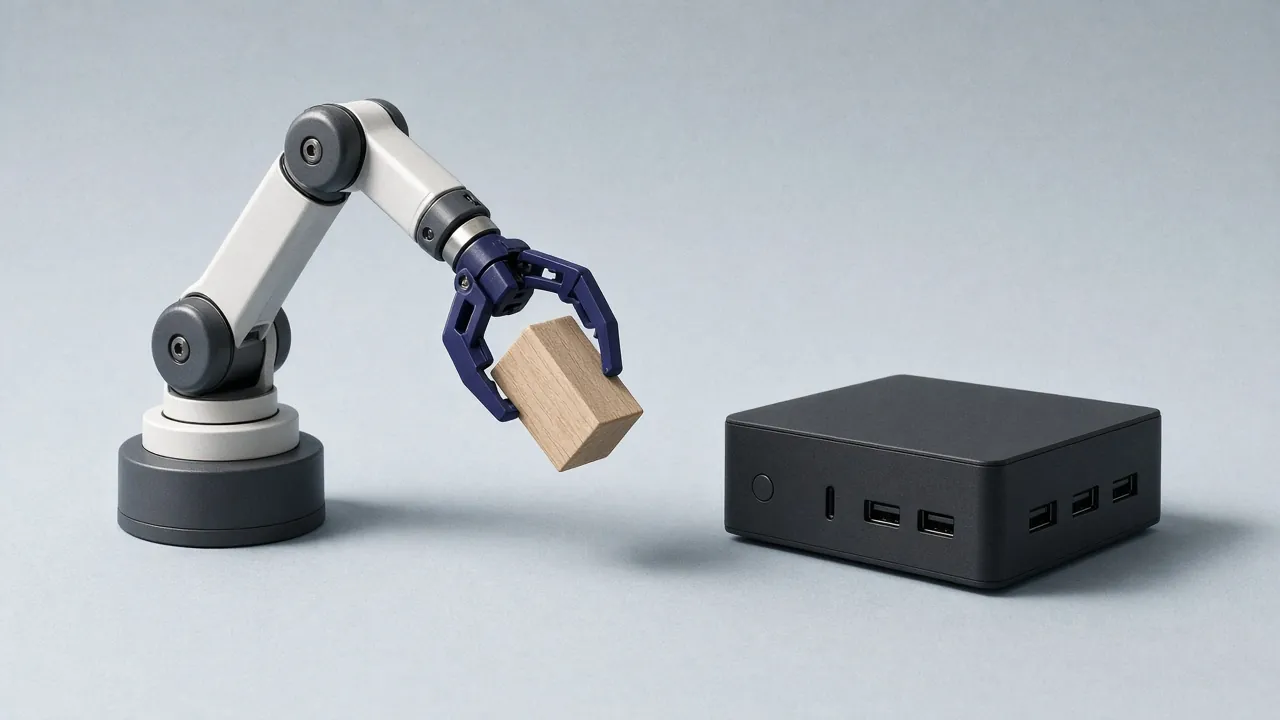
A small desktop robot arm holding a wooden block, with a blue gripper, beside a mini PC
Image: generated with Grok Imagine

The real example

LeRobot SO-101 + SmolVLA

Hugging Face's LeRobot library supports low-cost arms such as the SO-101 and ships SmolVLA, a 450M vision-language-action model. The LeRobot docs recommend recording about 50 episodes of your task; their reference pick-and-place dataset used 50 episodes across five cube positions, and 25 episodes was not enough. Fine-tuning for 20,000 steps takes about 4 hours on a single A100. On the LIBERO simulation benchmark the SmolVLA paper reports 87.3% average success, against 86.0% for π0 (3.3B) and 76.5% for OpenVLA (7B).

Sources: LeRobot: SmolVLA · LeRobot: SO-101 · SmolVLA paper (arXiv:2506.01844)

Why run it locally

The robot needs answers in milliseconds, next to the camera. A cloud round-trip is too slow and too fragile for closing a control loop.

Recommended stack

Three tiers built from our builds. Weights-in-memory is our arithmetic (parameters × bits), checked against each device's usable memory; it excludes KV cache and runtime overhead. Runtime compatibility is not validated.

Budget

Value 16 GB

$1,173Sample

16 GB on GeForce RTX 5060 Ti 16 GB

Weights ≈ 0.9 GB of 15.5 GB usableEstimate

Excludes KV cache and runtime overhead. Runtime compatibility is not validated.

Inference is easy at 450M parameters; fine-tuning is slower than on an A100 but works.

Runtime: LeRobot (PyTorch, CUDA)

Pro

Dual-GPU 48 GB

$4,044Sample

48 GB on 2× RTX 3090 (used) 48 GB

Weights ≈ 6.7 GB of 47.0 GB usableEstimate

Excludes KV cache and runtime overhead. Runtime compatibility is not validated.

Train larger policies and run several experiments at once.

Runtime: LeRobot multi-GPU training

Setup outline

  1. Build or buy an SO-101 leader-and-follower arm pair and calibrate it with LeRobot.
  2. Record about 50 teleoperated demonstrations, repeating each variation of the task.
  3. Push the dataset to the Hub (it can stay private) and fine-tune smolvla_base.
  4. Run the policy on the follower arm, watch closely, and record more data where it fails.

Limits

  • LIBERO is a simulation benchmark. Real-world success depends on your data, lighting and calibration.
  • Hobby arms have small payloads and weak precision; keep fingers and pets clear.
  • A non-commercial licence applies to some VLA models, such as NVIDIA GR00T N1.5.

Next: A private image studio

Build prices come from our build datasheets: GPUs and devices are sourced retail or sold prices; other parts are sample prices until sourced, and the flag on each total says which. Model links go to our datasheets, where each parameter count and licence was checked against the Hugging Face API.